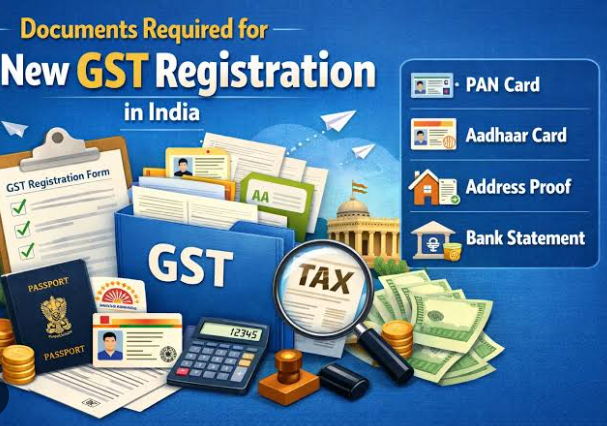
Documents Required for GST Registration in India
GST registration is an important step for businesses (documents required for GST registration) that need to comply with India’s Goods and Services Tax system. However, many business owners are unsure about the documents they need to submit during registration.
The good news is that the documents required for GST registration are usually easy to arrange. However, the exact documents can vary based on the type of business, business address, and nature of the business.
In this guide, we will explain the documents required for GST registration in India, the documents needed for different business structures, and some common mistakes you should avoid.
What Is GST Registration?
GST registration is the process through which a business gets registered under the Goods and Services Tax system. After successful registration, the business receives a unique GST Identification Number (GSTIN).
A registered business can collect GST from customers, claim eligible Input Tax Credit, and meet its GST compliance requirements.
Businesses that meet the applicable GST registration conditions generally need to register. However, some businesses may also choose voluntary registration even when registration is not mandatory.
Who Needs GST Registration?
GST registration requirements depend on factors such as turnover, business activity, location, and the type of supplies made by the business.
For example, certain businesses may need registration when their turnover crosses the applicable threshold. In addition, some categories of businesses may need GST registration even if their turnover is below the normal threshold.
Therefore, businesses should check the latest GST rules before applying.
Documents Required for GST Registration
The documents required for GST registration can differ depending on the business structure. Nevertheless, most applicants need some basic documents and information.
Here are the main documents generally required:
1. PAN Card
A PAN card is one of the key documents required for GST registration. The PAN of the business or the person applying for registration is used to create the GST application.
For a proprietorship, the proprietor’s PAN is generally used. For companies and other entities, the entity’s PAN is generally required.
Therefore, make sure that the PAN details entered in the GST application match the relevant PAN records.
2. Aadhaar Card
Aadhaar details may be required as part of the GST registration and authentication process, depending on the applicant and the process applicable at the time of registration.
For businesses such as proprietorships, the Aadhaar details of the proprietor may be relevant. Similarly, details of authorised persons may be required for other business structures.
Keep the Aadhaar details accurate to avoid problems during authentication.
3. Photograph
The GST registration application generally requires photographs of the relevant promoters, partners, proprietors, directors, or authorised persons, as applicable.
The photograph should meet the portal’s prescribed format and size requirements.
It is better to keep a recent and clear photograph ready before starting the application.
4. Proof of Business Address
Proof of the principal place of business is another important document for GST registration.
The exact document depends on whether the business owns, rents, or uses the property with permission.
Common examples include:
Electricity bill
Property tax receipt
Municipal record
Rent or lease agreement
Ownership document
Consent letter or letter of authorisation
Other applicable address proof
If the business operates from a rented property, the applicant may need to provide the rent or lease agreement along with suitable ownership or address proof.
5. Bank Account Details
Bank account details may be required for GST compliance and can be added as applicable under the GST registration process.
Depending on the current GST portal requirements, businesses may need to provide bank account information after registration or within the prescribed period.
Therefore, businesses should keep their bank details ready and ensure that the account information is accurate.
6. Digital Signature Certificate
A Digital Signature Certificate (DSC) is generally required for certain categories of taxpayers, such as companies and LLPs, for authentication on the GST portal.
For example, an authorised signatory of a company may need to use a DSC while completing the GST registration process.
However, the requirement can vary based on the type of taxpayer and the applicable GST process.
7. Business Constitution Documents
Businesses may also need documents that prove their legal constitution.
The documents can differ based on the type of business.
For example:
Partnership Firm: Partnership deed
LLP: LLP agreement and incorporation documents
Private Limited Company: Certificate of Incorporation and related company documents
Trust: Trust deed
Society: Registration certificate and governing documents
Other entities: Relevant registration or constitution documents
These documents help establish the legal identity and structure of the business.
Documents Required for GST Registration Based on Business Type
The GST registration document list changes according to the business structure. Therefore, it is useful to understand the requirements for each type of business.
GST Registration Documents for Proprietorship
A sole proprietor usually needs the following documents:
PAN card of the proprietor
Aadhaar card of the proprietor
Recent photograph
Proof of principal place of business
Bank account details, as applicable
Additional documents, if required based on the business or premises
Since a proprietorship does not have a separate legal identity from its owner in the same way as a company, the proprietor’s personal documents are commonly used.
GST Registration Documents for Partnership Firm
A partnership firm may generally need:
PAN of the partnership firm
PAN and Aadhaar details of partners, as applicable
Partnership deed
Photographs of relevant partners or authorised persons
Proof of principal place of business
Bank account details, as applicable
Authorisation document for the authorised signatory
DSC, where applicable
The partnership deed is particularly important because it establishes the constitution of the firm.
GST Registration Documents for LLP
For an LLP, the applicant may generally need:
PAN of the LLP
Certificate of Incorporation
LLP agreement
PAN and Aadhaar details of designated partners, as applicable
Photographs of relevant persons
Proof of principal place of business
Authorisation for the authorised signatory
DSC, where applicable
Bank account details, as applicable
Make sure that the information in the GST application matches the LLP’s official records.
GST Registration Documents for Private Limited Company
A private limited company may generally need:
PAN of the company
Certificate of Incorporation
PAN and Aadhaar details of relevant authorised persons
Photograph of the authorised signatory
Proof of principal place of business
Authorisation or board-related document, as applicable
DSC of the authorised signatory
Bank account details, as applicable
The company’s legal name and other details should match its incorporation records.
GST Registration Documents for Trust or Society
A trust or society may need documents such as:
PAN of the entity
Trust deed or society registration documents
PAN and Aadhaar details of authorised persons, as applicable
Photograph of the authorised signatory
Proof of principal place of business
Authorisation document
Bank account details, as applicable
The exact requirements can depend on the entity and the nature of its activities.
Additional Documents for GST Registration
In some cases, the GST department may require additional information or documents.
For example, you may need additional documents when:
The business operates from a rented property.
The property is owned by another person.
The business has multiple places of business.
The applicant has an authorised signatory.
The business has a specific type of constitution.
The business carries out activities that require additional information.
The GST officer asks for clarification or supporting documents.
Therefore, applicants should not rely on a single fixed checklist for every business.
Common Mistakes While Submitting GST Registration Documents
Submitting incorrect or unclear documents can delay the GST registration process. Therefore, review your application carefully before submitting it.
Here are some common mistakes to avoid:
Using Incorrect PAN Details
Always enter the correct PAN details. A mismatch between the application and official records can create problems during verification.
Uploading Unclear Documents
Make sure scanned documents are clear and readable. Blurry documents can make verification difficult.
Providing an Incorrect Business Address
The principal place of business should match the address proof submitted with the application.
Missing Authorisation Documents
If someone is applying as an authorised signatory, provide the required authorisation documents.
Ignoring Portal Requirements
The GST portal may specify file formats, file sizes, and other requirements. Therefore, check these requirements before uploading your documents.
How to Prepare Documents for GST Registration
You can make the GST registration process easier by preparing your documents in advance.
First, identify your business structure. Next, collect your PAN, identity documents, photographs, business address proof, and constitution documents.
Then, check whether your business needs any additional documents. After that, scan the documents clearly and keep the required files in the prescribed format.
Finally, compare all the information before submitting the GST registration application.
This simple approach can help reduce errors and avoid unnecessary delays.
GST Registration Process in India
Once you have prepared the required documents, you can proceed with the GST registration application.
The general process includes the following steps:
Visit the GST portal.
Start a new registration application.
Enter the required basic details.
Verify the relevant information.
Complete the application using the applicable authentication method.
Enter business and promoter details.
Provide the principal place of business details.
Upload the required documents.
Submit the application.
Complete any further verification or clarification requested by the GST authorities.
Receive the GST registration approval and GSTIN if the application is approved.
The exact process and requirements can change. Therefore, always follow the instructions shown on the official GST portal when submitting your application.
Frequently Asked Questions About GST Registration Documents
What are the main documents required for GST registration?
The main documents generally include PAN, identity details, photographs, business address proof, business constitution documents, and other documents applicable to the taxpayer.
Is Aadhaar required for GST registration?
Aadhaar authentication may apply depending on the taxpayer and registration process. Therefore, applicants should follow the current requirements shown during the GST registration process.
Is a rent agreement required for GST registration?
A rent or lease agreement may be required when the business operates from rented premises. Additional address or ownership proof may also be required, depending on the circumstances.
Is a bank account required for GST registration?
Bank account information can be added as required under the GST rules and portal process. Businesses should keep valid bank details available for compliance purposes.
Is DSC mandatory for GST registration?
A DSC is generally required for companies and LLPs and certain other categories as prescribed. The requirement depends on the taxpayer type and applicable GST rules.
Can I register for GST without a business office?
A business does not always need a traditional commercial office. However, the applicant must provide a valid principal place of business and appropriate supporting documents as required under GST rules.
How long does GST registration take?
The time required can vary based on the application, verification, authentication, and whether the GST department asks for additional information.
Conclusion
Preparing the right documents is one of the most important parts of the GST registration process. While the exact requirements depend on the business structure and circumstances, most applicants need PAN, identity details, photographs, business address proof, and relevant business documents.
Therefore, identify your business type first and prepare the documents that apply to your situation. Also, check the latest requirements on the GST portal before submitting your application.
With the right documents and accurate information, you can make the GST registration process smoother and reduce the chances of delays or queries.